
Product Page
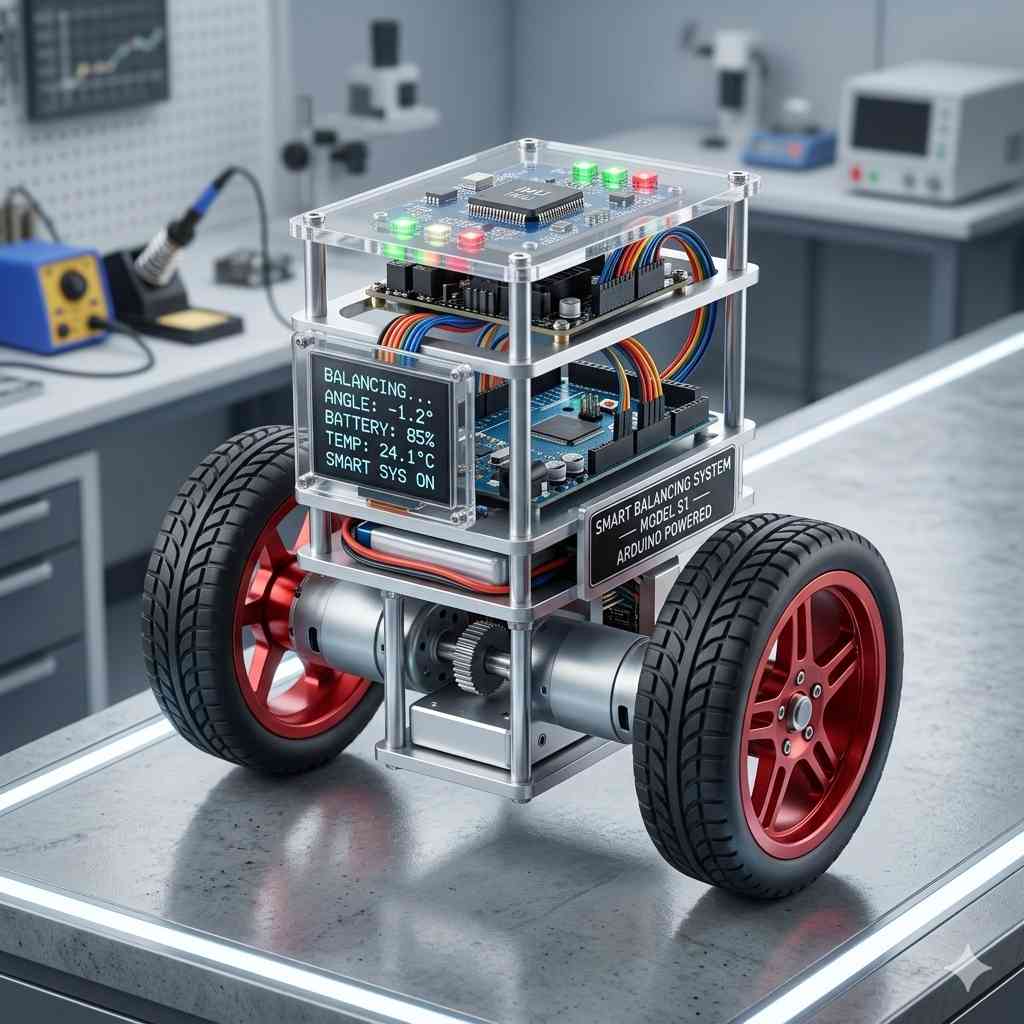
Self Balancing Robot Using Arduino and DC Motor
₨ 35,000
[yith_wcwl_add_to_wishlist]
Need some help?
Contact Us
Product Ships in
2-3-business Days
Payment Methods:
Buy Self Balancing Robot Using Arduino and DC Motor | Smart Two-Wheel Balancing System
The Self Balancing Robot using Arduino and DC Motor is an intelligent robotics project designed to demonstrate real-time balance control using sensors, microcontrollers, and motor drivers. This system works on the principle of dynamic stabilization, similar to how a human maintains balance while standing. The first step is hardware setup. The robot is built using an Arduino board, DC motors, motor driver module, wheels, and a gyroscope/accelerometer sensor (such as MPU6050). All components are mounted on a stable chassis to create a two-wheel balancing structure.
Buy Self Balancing Robot Using Arduino and DC Motor | Smart Two-Wheel Balancing System
The second step is sensor calibration. The gyroscope and accelerometer continuously measure tilt angle and motion. This data is sent to the Arduino, where it is processed in real-time. Proper calibration ensures accurate readings and stable performance. The third step is control algorithm implementation. A PID (Proportional-Integral-Derivative) control algorithm is programmed into the Arduino. This algorithm calculates the required motor speed and direction to keep the robot upright by correcting any tilt instantly.
The fourth step is motor control. The Arduino sends signals to the motor driver, which adjusts the DC motors accordingly. The motors move forward or backward to maintain balance dynamically. Finally, testing and tuning are performed. PID values are adjusted to achieve smooth and stable balancing. Once optimized, the robot can balance itself continuously, even with slight disturbances. This project is ideal for learning robotics, control systems, and embedded programming, making it perfect for students and hobbyists.
Key Benefits:
- Maintains balance automatically in real time
- Uses Arduino for intelligent control processing
- Integrates gyroscope and accelerometer sensors
- Implements PID algorithm for stability control
- Drives DC motors with precise speed adjustment
- Responds instantly to tilt and movement changes
- Demonstrates advanced robotics concepts clearly
- Supports easy hardware assembly and setup
- Provides hands-on learning experience
- Enhances understanding of control systems
- Operates on a compact two-wheel design
- Allows real-time data processing and feedback
- Offers customizable programming options
- Improves STEM and engineering skills
- Ensures stable and smooth balancing performance
YouTube Video
Related products
-
CNG/LPG Gas Leakage Detection & Accident Prevention System
₨ 14,000 -

14 to 15v 2a Switching Adapter Power Supply
₨ 750 -

Petrol Pump Fuel Dispenser External Display | Digital Counter, Temperature & Human Display System
₨ 90,000 -

Time Lapse Timed Photography On Raspberry Pi Zero Board Student Projects
₨ 13,000