Product Page

BLDC Motor Failure Detection System For Drone Safety in Pakistan
₨ 11,000
[yith_wcwl_add_to_wishlist]
Need some help?
Contact Us
Product Ships in
2-3-business Days
Payment Methods:
BLDC Motor Failure Detection System Student Proejcts Pakistan
Drones are widely used across several fields, including aerial photography, surveying, inspection, agriculture, and recreation. Despite their growing importance, many drones develop hardware faults such as motor disconnection, ESC faults, missing propellers, overcurrent conditions, or low battery voltage before take-off. These issues can cause sudden imbalance, crashes, costly component damage, and loss of user confidence.
Apart from software diagnostics or GPS-based checks, drone controllers typically perform only basic system checks. As a result, critical faults often remain undetected. This system introduces a smart drone safety mechanism that functions as a pre-flight safety guardian. It monitors motor current and battery voltage using a precision current sensor and a voltage divider network. With a single button press, the ESC powers the motor for a short, controlled test cycle while the system analyses real-time current behaviour and battery health.
Very low current may indicate ESC disconnection or non-responsiveness. Low current may also suggest loose motor wiring or partial disconnection. Mid-range current indicates that the motor is operating without a propeller. Excessive current points to an overloaded or mechanically stressed motor, while low voltage indicates a weak or unsafe battery condition. Fig. 1 shows the author’s prototype.
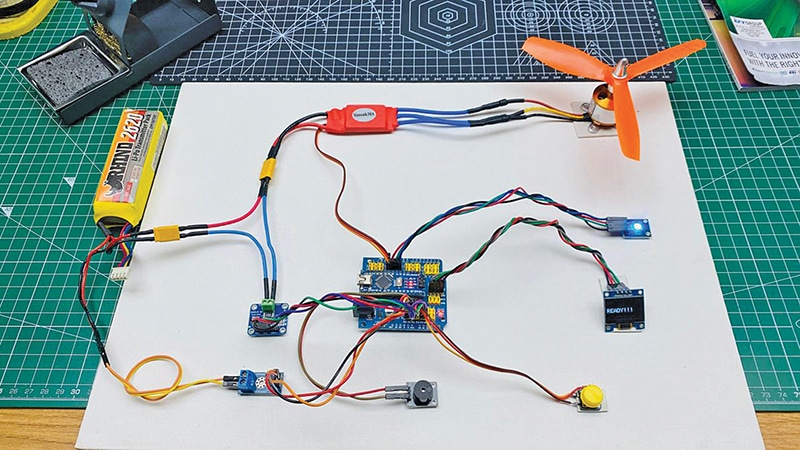
This system is simple, affordable, and practical. It can be used during assembly, maintenance, or routine pre-flight checks, improving reliability and promoting safer drone operation. The system also supports future expansion, including multi-motor testing, data logging for long-term motor health tracking, and wireless monitoring integration. The components required to build this system are listed in the Bill of Materials Table 1.
| Table 1 Bill of Materials | |
| Components | Quantity |
| Arduino Nano (MOD1) | 1 |
| Arduino Nano expansion board | 1 |
| 2.4cm (0.96”) I2C OLED display (OLED) | 1 |
| Buzzer module (B1) | 1 |
| INA219 current sensor module (S1) | 1 |
| Voltage sensor module (S2) | 1 |
| Electronic speed controller (ESC) | 1 |
| BLDC motor (M1) | 1 |
| RGB LED module (U2) | 1 |
| Push button switch (SW1) | 1 |
| 220Ω resistor (R1) | 1 |
| 10kΩ resistor (R2) | 1 |
| Jumper wires (male-male/mixed) | As required |
| 12V Li-Po drone battery (U1) | 1 |
Software coding
The Arduino IDE platform is used to write, compile, and upload code to the Arduino board. It supports C/C++-based programming, provides a simple user interface, includes built-in libraries, offers serial monitoring, and ensures cross-platform compatibility. This environment makes embedded system development accessible for both beginners and professionals.
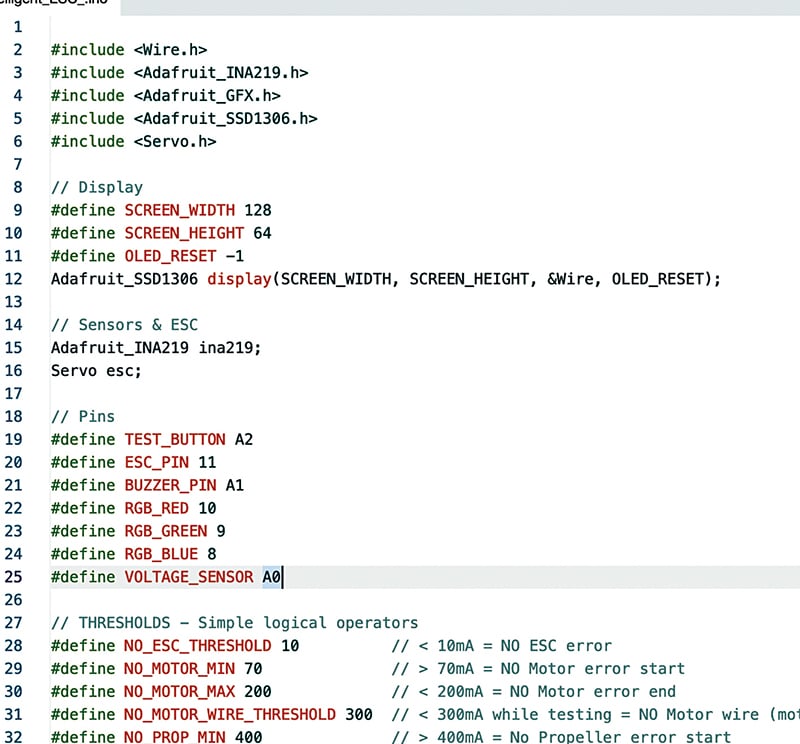
The INA219 sensor is used to measure current, while the SSD1306 OLED display is used for data visualisation. To interface these devices, the libraries Adafruit_INA219.h, Adafruit_GFX.h, and Adafruit_SSD1306.h must be installed using the Library Manager.
After installing the required libraries, the pins for the sensors, RGB LED, and ESC PWM signal are defined in the code. The Servo library generates the PWM signal required to control the ESC. Fig. 2 shows a snippet of the source code. The program displays the system status using the RGB LED, and the corresponding RGB status indications are listed in Table 2.